
Hybrid Intelligence in Geosciences: Leveraging AI to Empower Human Insight
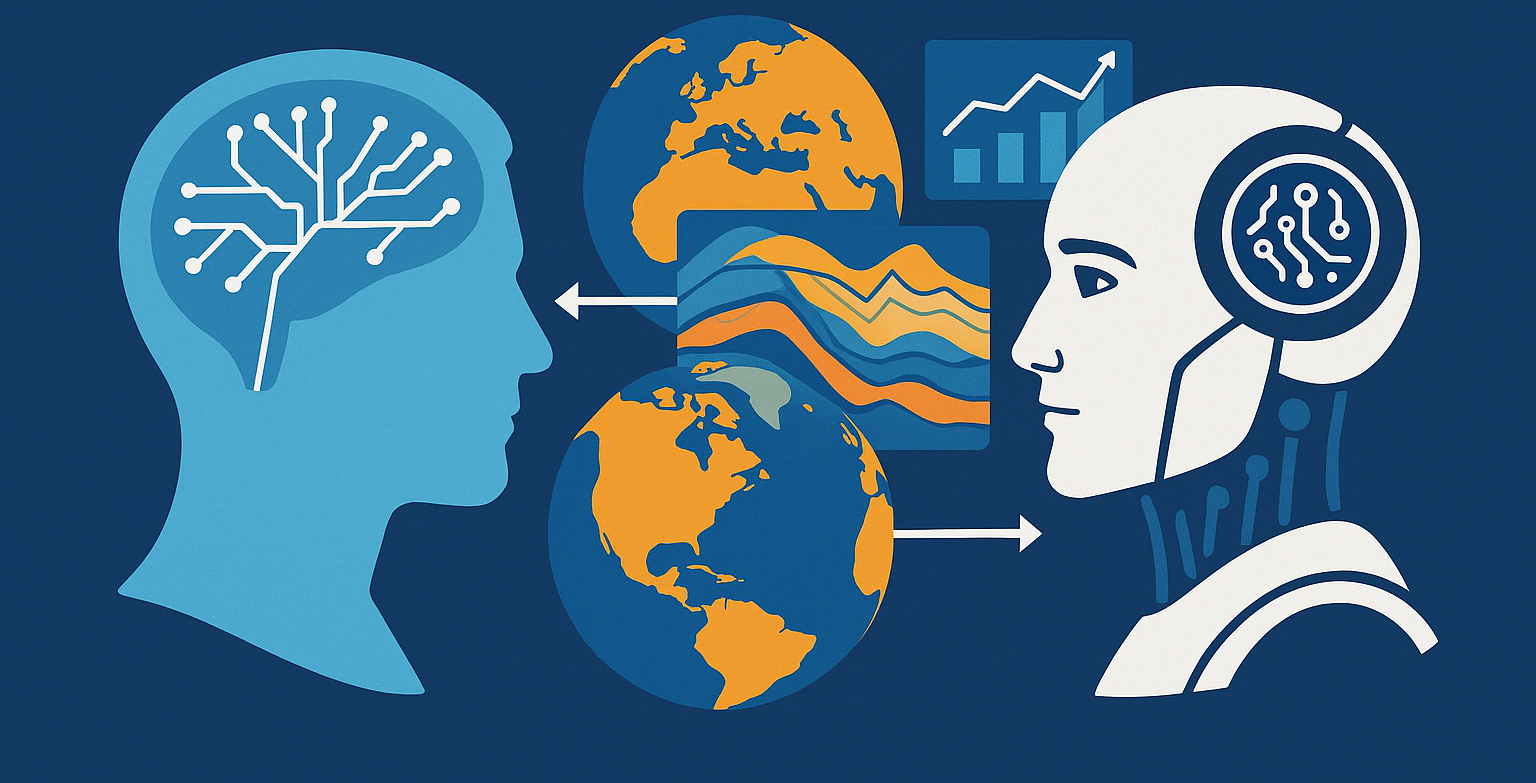
HACID partners from the Met Office are co-organising a session at the European Geosciences Union General Assembly 2026 (Session ITS1.6/ESSI1.6). It will focus on how hybrid intelligence – the integration of human and artificial intelligence – can augment geoscientific research and innovation, rather than replace human expertise.
Session description: Hybrid intelligence refers to integrated systems of human and machine intelligence, combining the adaptive, contextual, and ethical reasoning of humans (individually and collectively) with the computational power and scalability of AI. This session will explore practical applications of hybrid intelligence in geosciences – covering areas such as knowledge curation, decision support, data analytics, science communication, and actionable science. We will also address the ethical and societal dimensions of human‐centred AI, ensuring that scientists remain at the core of innovation. For geoscientists, hybrid intelligence means fusing deep Earth science expertise with AI-driven insights to tackle complex environmental and societal challenges. The emphasis is on AI, including generative AI, as a tool to empower and extend human insight in geoscience workflows, not to supplant it. We welcome contributions that advance the discussion on harnessing AI responsibly for the benefit of both humanity and the progress of geosciences.
Contributions may address, but are not limited to, the following topics:
- AI tools for geoscientific analysis and outreach: Applications of AI tools that facilitate data analysis, result dissemination, public outreach, education, and the translation of geoscientific research into actionable insights.
- AI-enhanced decision support systems: Development of AI-driven decision support systems for environmental management, hazard assessment, or resource planning, where AI augments human decision-making in complex scenarios.
- Leveraging knowledge graphs: Integration of expert-curated knowledge bases or knowledge graphs with AI algorithms to improve data discovery, hypothesis generation, or predictive modelling in Earth sciences.
- Generative AI and Deep Learning in geosciences: Innovative uses of deep learning models and generative AI (e.g. for data simulation, image interpretation, or scenario generation) that assist geoscientists in their research, with appropriate human oversight.
- Geoscience-specific AI agents: Development of domain-specific intelligent agents or “agentic” systems (virtual assistants, automated workflows, etc.) tailored to geoscientific applications and guided by expert input.
- Ethical considerations of applying AI in geosciences: Discussions on the ethical dimensions of using AI in geosciences – including issues of transparency, bias, accountability, and how to ensure the adoption of AI is responsible and human-centred in our field.
Submission details:
- Abstract submission deadline: 15 January 2026, 13:00 CET.
- How to submit: You can submit your abstract through the session page https://meetingorganizer.copernicus.org/EGU26/session/57542.
We look forward to your contributions and an engaging discussion on the synergy between artificial intelligence and human insight in geosciences.
News
Yet another video from our series explaining hybrid collective intelligence and its implications to…
In this new video, we explain what is hybrid collective intelligence—the improved ability to solve…
HACID partners from the Met Office are co-organising a session at the European Geosciences Union…

Our latest study published on PNAS demonstrates that the combination of human expertise with the capacity…

People ➞